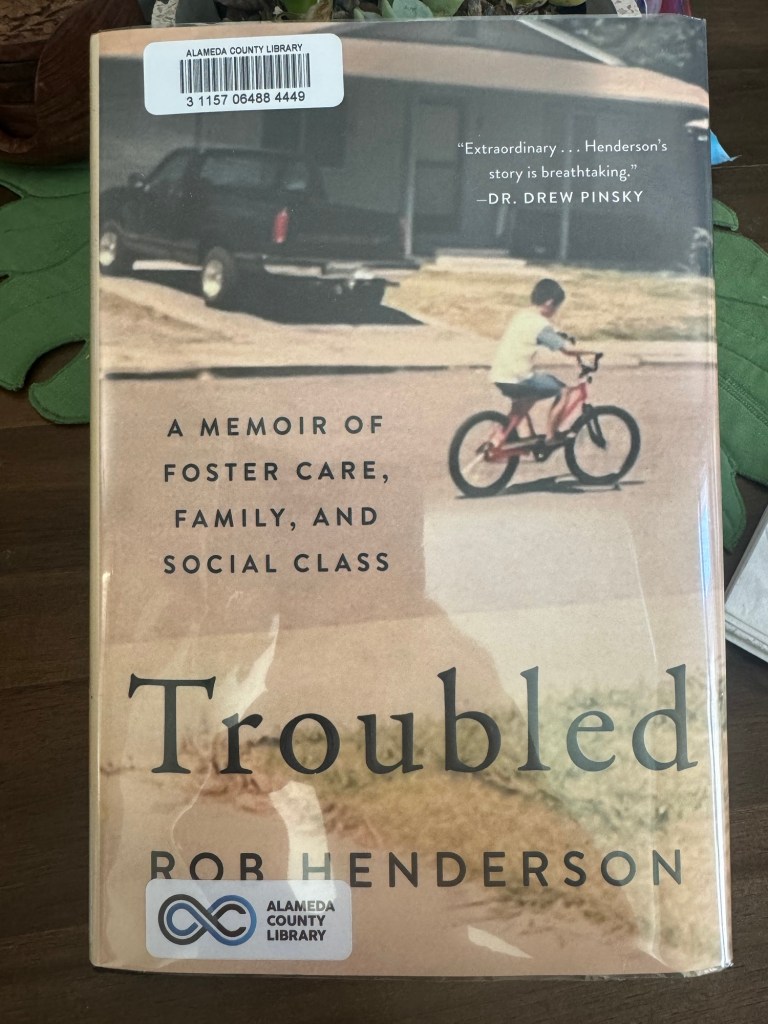
“When educated Americans discuss what’s best for kids, we tend to talk about education as the be-all and end-all, when it should be seen more as the fortunate benefit of a warm and loving upbringing.”
I didn’t expect to, but I devoured Rob Kim Henderson’s memoir in 2 days — a story about a foster child, and his observations about family and social class.
Much of the book is about the traumatic instability of being a foster child. He remembers being ripped from his mother’s arms by the police. She was an addict, sent back to Korea. He never knew his Latino father. From there, he was moved from one foster “family” to the next—9 in total—never getting the stability he craved.
Eventually, he was adopted by a poor working class family, in Red Bluff, CA—a small, also poor, and dangerous town. But like most of his peers, dad left, and, like his peers, Rob accelerated his life of drinking, smoking, fighting, thieving, and truancy. He did love reading though. This sobering portrait of growing up as a foster child in poverty alone is worth the read. Most of his friends now are barely in relationships, barely employed, in prison, or dead.
But Rob also has something to share about class. Rob eventually “got out”—a statistical miracle for a foster child. He joined the military, excelled, got help for his alcoholism, and was then accepted into one of the most elite institutions in the world: Yale. From there, Cambridge.
But Yale was a curiosity to this adopted foster kid from poor Red Bluff. First, almost everyone was from stable, intact, and well-educated families. Second, when a campus protest broke out over a professor’s email about the school’s Halloween costume policy, these very privileged students spoke of the being “triggered” and deep “harms”—when he asked to understand, he was told he was too “privileged” to understand, presumably because he was half Asian (or looked white?).
But third, he came to observe what he now calls “luxury beliefs”—beliefs that confer status on the elite, but on the backs of the poor. In the past, Rob says, the rich could signal their status through luxury cars, clothes, etc. But the middle class can have all that now. So today, they signal through luxury beliefs. This is where Rob steps on some toes. “Defund the police” for example, is easy to say for his wealthy classmates who live in relative safety. And yes, he says, the poor are more likely to be incarcerated, but they’re also overwhelmingly more likely to live in neighborhoods most susceptible to crime. Or decriminalizing drugs, a harmless recreational activity for the rich, but the road to destruction for the poor. But, most personally for Rob, the deconstruction of marriage and family. Most of his peers advocated things like polyamory and called marriage “just a piece of paper” (something, he says, they don’t seem to apply to their Yale degrees). But he, and most of his friends in Red Bluff would’ve traded the world to have a stable two-parent home. And when he asked, nearly all his Yale friends planned to be in a monogamous marriage themselves one day. He thought his fellow Yalie’s would use their privilege to help the poor, to the contrary – they used the poor to bolster their own privilege.
In the end, we are all searching. Status, belonging, love. The middle class, he says, seek status through education. This speaks to me and my cohort. But he closes the book with a conversation with a parent, asking how their child could grow up to be successful like Rob. “Should we read to our child?” they ask.
“Yeah, but not because it will expand his vocabulary. Read to him because it will remind him that you love him.”

 Brian Hui
Sent from my iPhone
<
div dir=”ltr”>
<
blockquote type=”cite”>
Do you think the Yale students thought he was “too privileged” because he was Asian or because they assumed he was white? I’ve heard him tell the story on podcasts and it seemed to me that he implied the latter.
Regardless, thanks for the review. I’ve been meaning to read this book and now will make it a priority to do so.
Hmmm, you may be right! Let me know what you think when you read it!
I’ve been following Henderson’s blog since March anticipating that his blog would contain many element of the book, which it sounds like it does but now have more reason to engage with a fuller narrative. I always enjoy reading your writing.
Thank you. Henderson is connected to some weird crowds, but I think his story is still sobering, and his ideas still worth considering